Spray Nozzles Parts
841 products available
Pressure washer nozzles are color-coded by spray angle — red (0°), yellow (15°), green (25°), white (40°), and black (65°, soap) — and sized by an orifice number stamped on the tip. Matching the orifice to your pump's GPM and PSI rating matters more than picking a color for the job, since an undersized orifice restricts flow and overworks the pump, while an oversized one bleeds off pressure before it reaches the surface.
(10)X-JET M5 DELUXE VARIABLE NOZZLE #13 KIT
SKU: 6245
Variable-pattern nozzle. SKU 6245.
(100)GP QC 5 NOZZLE KIT 4.0 (0,15,25,40,6540)
SKU: 5722
A five-piece quick-connect nozzle kit in 4.0 orifice, covering 0° tip, 15° tip, 25° tip, 40° tip, and 65° soap tip — one kit for blasting, general SKU 5722.
(100)GP QC 5 NOZZLE KIT 4.5 (0,15,25,40,6540)
SKU: 5723
A five-piece quick-connect nozzle kit in 4.5 orifice, covering 0° tip, 15° tip, 25° tip, 40° tip, and 65° soap tip — one kit for blasting, general SKU 5723.
(15)X-JET M5DS TWIST ADJ. SOAPER NOZZLE 2-3 GPM
SKU: 7013
Chemical applicator (x-jet style). SKU 7013.
(15)X-JET M5DS TWIST ADJ. SOAPER NOZZLE 3-7 GPM
SKU: 7019
Chemical applicator (x-jet style). SKU 7019.
(15)X-JET M5DS TWIST ADJ. SOAPER NOZZLE 7-12 GPM
SKU: 7020
Chemical applicator (x-jet style). SKU 7020.
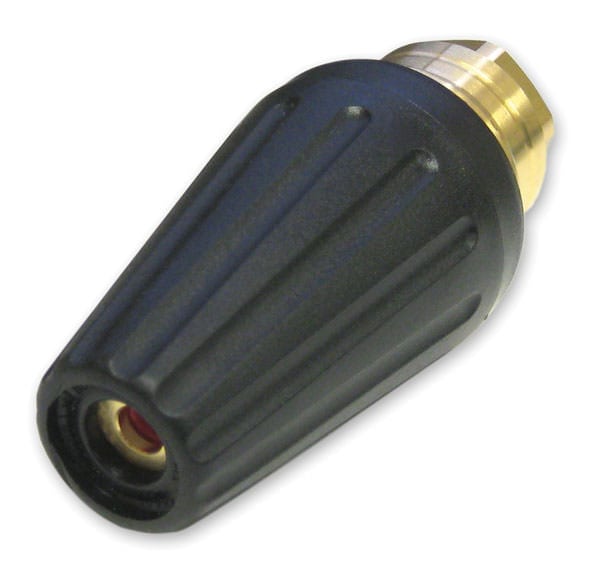
(20)ST-457 5.0 TURBO NOZZLE 6000 PSI 212 DEG BLACK
SKU: 4567
Rotary turbo, 5.0 orifice, 6000 PSI max. SKU 4567.
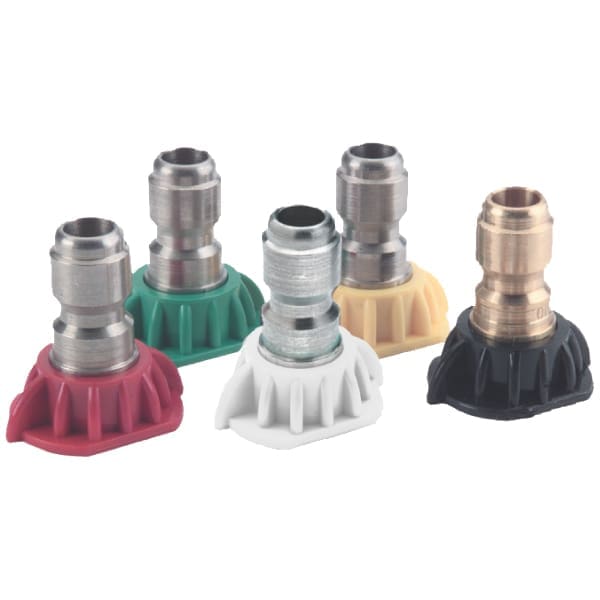
(200)QC 0004 RED NOZZLE
SKU: 5086
Quick-connect fan, 0° fan, 04 orifice, 1/4" quick-connect. SKU 5086.
(200)QC 0005 RED NOZZLE
SKU: 5088
Quick-connect fan, 0° fan, 05 orifice, 1/4" quick-connect. SKU 5088.
(200)QC 1504 YELLOW NOZZLE
SKU: 5179
Quick-connect fan, 15° fan, 04 orifice, 1/4" quick-connect. SKU 5179.
(200)QC 1505 YELLOW NOZZLE
SKU: 5187
Quick-connect fan, 15° fan, 05 orifice, 1/4" quick-connect. SKU 5187.
(200)QC 2503 GREEN NOZZLE
SKU: 5236
Quick-connect fan, 25° fan, 03 orifice, 1/4" quick-connect. SKU 5236.
(200)QC 2504 GREEN NOZZLE
SKU: 5239
Quick-connect fan, 25° fan, 04 orifice, 1/4" quick-connect. SKU 5239.
(200)QC 2505 GREEN NOZZLE
SKU: 5241
Quick-connect fan, 25° fan, 05 orifice, 1/4" quick-connect. SKU 5241.
(200)QC 4004 WHITE NOZZLE
SKU: 5277
Quick-connect fan, 40° fan, 04 orifice, 1/4" quick-connect. SKU 5277.
(200)QC 4005 WHITE NOZZLE
SKU: 5284
Quick-connect fan, 40° fan, 05 orifice, 1/4" quick-connect. SKU 5284.
(25)ROTOJET 3700 PSI 4.5 NOZZLE (1060040600)
SKU: 4801
Rotary turbo, 4.5 orifice, 3700 PSI max. SKU 4801.
(25)ROTOJET 5800 PSI 12.0 NOZZLE
SKU: 4819
Rotary turbo, 5800 PSI max. SKU 4819.
(250)GP QC 15055 YELLOW NOZZLE
SKU: 1815
Quick-connect fan, 15° fan, 055 orifice, 1/4" quick-connect. SKU 1815.
(300)QC 00065 RED NOZZLES
SKU: 4692
Quick-connect fan, 0° fan, 065 orifice, 1/4" quick-connect. SKU 4692.
(300)QC 15065 YELLOW NOZZLES
SKU: 4717
Quick-connect fan, 15° fan, 065 orifice, 1/4" quick-connect. SKU 4717.
(300)QC 25065 GREEN NOZZLES
SKU: 4754
Quick-connect fan, 25° fan, 065 orifice, 1/4" quick-connect. SKU 4754.
(40)UR25 PA BLUE ROTATING NOZZLE 3650PSI 3.5
SKU: 6724
Rotary turbo, 3.5 orifice, 3650 PSI max. SKU 6724.
(40)UR25 PA BLUE ROTATING NOZZLE 3650PSI 5.5
SKU: 6723
Rotary turbo, 5.5 orifice, 3650 PSI max. SKU 6723.
Spray Nozzles Buying Guide
Reading the nozzle code
Standard quick-connect tips are stamped with a code like 15040: the first two digits are the fan angle, the last two or three are the orifice size in thousandths of an inch. So 15040 is a 15° nozzle with a 4.0 orifice. A smaller orifice number builds more pressure at a given flow; a larger one passes more flow at lower pressure.
Matching orifice to your pump
Use your pump's data-plate GPM and PSI, not the machine's advertised PSI rating alone — two washers both rated "3000 PSI" can need different orifice sizes if their GPM differs. If your GPM falls between two standard sizes, round up to the larger orifice; a slightly oversized orifice just costs a little working pressure, while an undersized one forces the pump above its rated PSI and overworks it.
Standard vs. turbo/rotary nozzles
A turbo nozzle spins a 0° pinpoint stream in a tight cone, combining the cutting power of a 0° tip with wider coverage — good for stripping concrete or heavy grime fast, but it draws more from the pump than an equivalent fan tip and isn't rated for delicate surfaces. A straight fan tip gives more control near edges, trim, and vertical surfaces.
Material: stainless vs. ceramic
Stainless steel resists corrosion and is plenty durable for occasional homeowner use. Ceramic-insert tips cost more up front but resist erosion far longer under continuous commercial or hot-water use, where standard tips wear out fastest.
Spray Nozzles FAQ
Can I use a smaller orifice to get more pressure?
Only within the range your pump is rated for. Going smaller than your GPM calls for forces the pump against near-dead-head pressure, which shortens seal and valve life. If you need more pressure, that's a pump/unloader question, not a nozzle question.
Why does my nozzle wear out so fast?
Hot water, hard water, and continuous daily use all accelerate orifice erosion. If you're replacing standard tips monthly, a ceramic-insert nozzle is usually the fix.
Do all pressure washers use the same nozzle size?
No — orifice size is matched to your specific pump's GPM and PSI, not to the brand or a generic "pressure washer" spec. Check your pump's data plate before ordering.